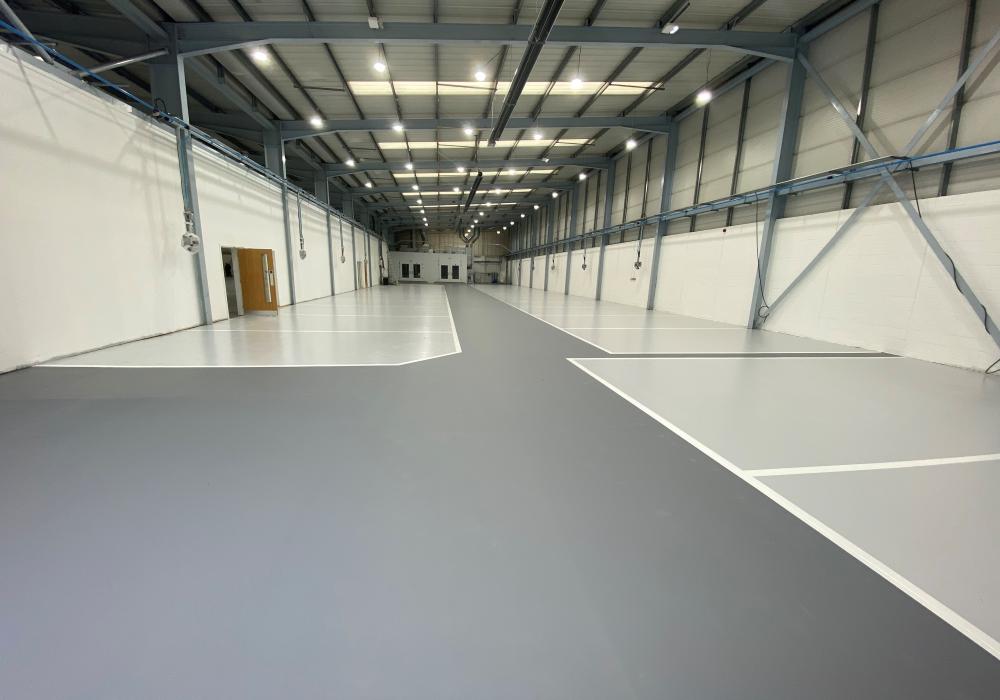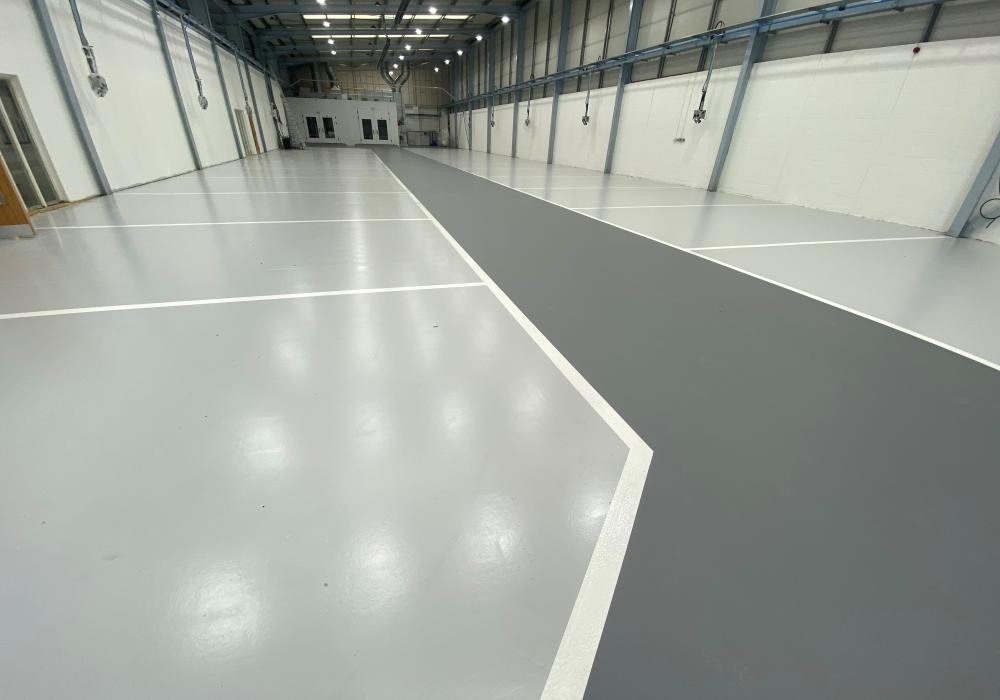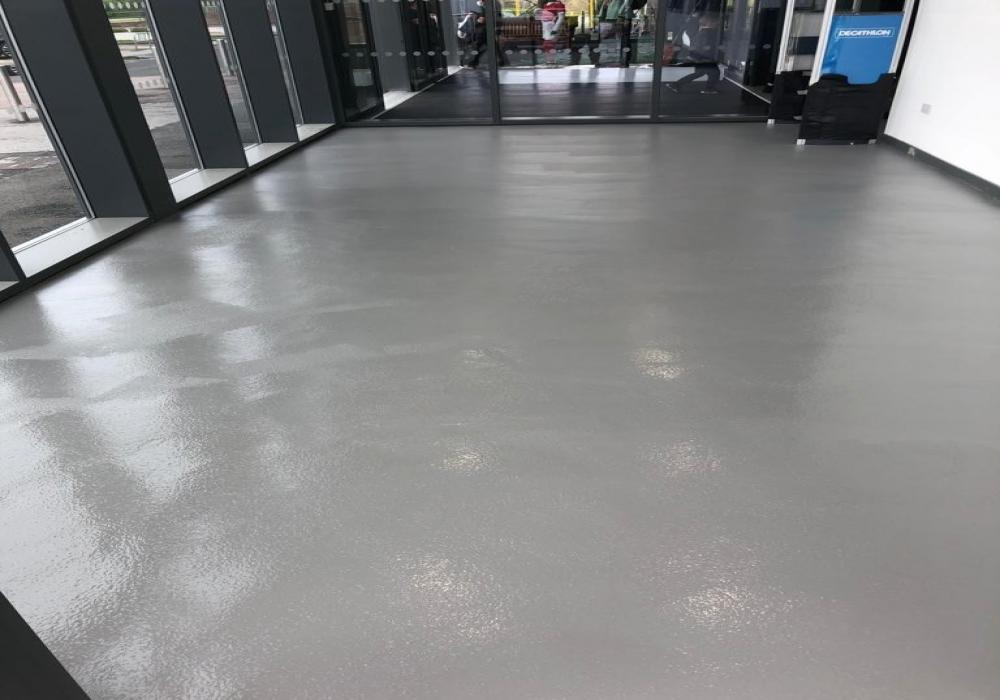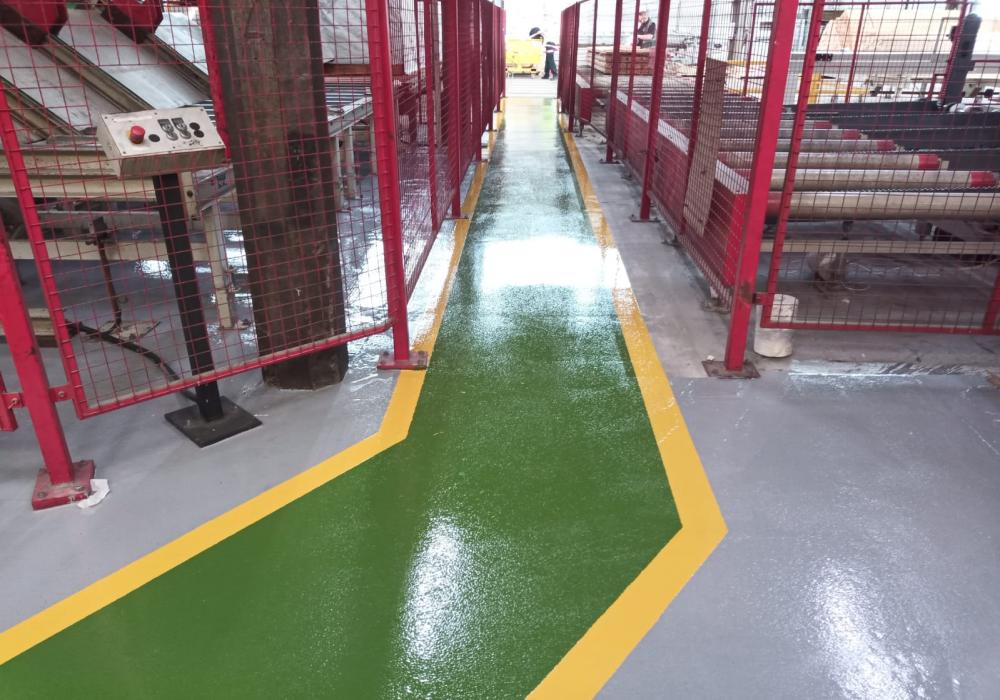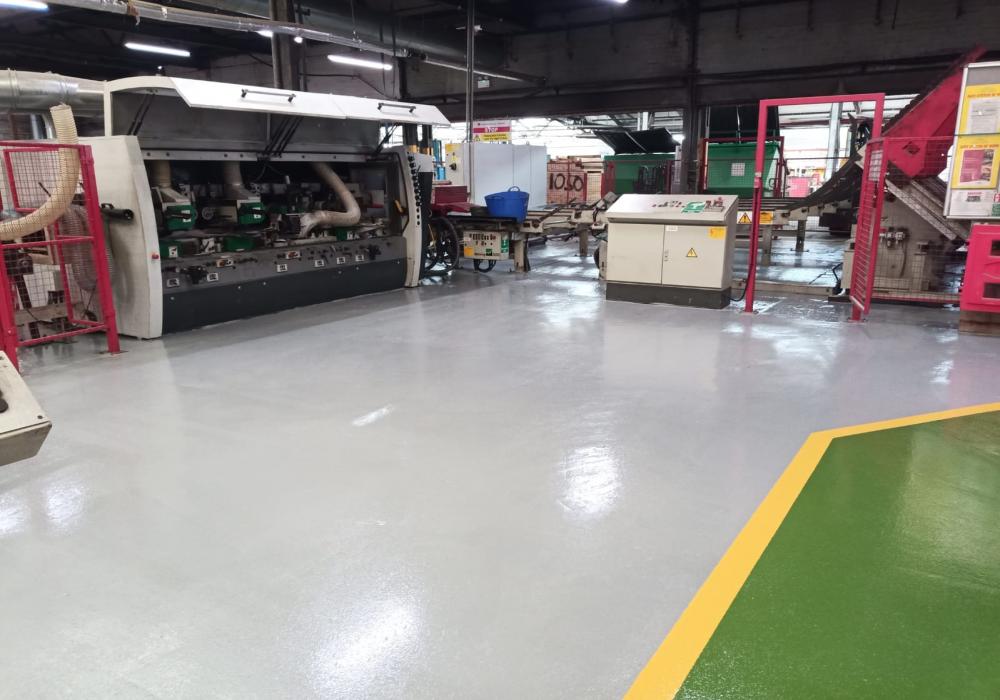

Flow applied resin flooring is poured onto the floor and spread to a set thickness, after which it flows out to a smooth, seamless surface. That is why it is also known as self-smoothing resin flooring or self-levelling resin flooring. Laid at 2mm to 4mm, it gives a highly smooth matt or gloss finish with very good chemical resistance and very good cleaning properties, for medium to heavy duty use.
What makes flow applied resin flooring different
Coatings are rolled on and follow every dip in the slab. Trowelled screeds are spread by hand and have a fine texture. A flow applied floor sits between the two: it is thick enough to bridge minor surface texture, but liquid enough to settle into a smooth, glass-like finish without trowel marks. The result is a floor that looks clean, reflects light well and can be wiped or scrubbed with little effort.
Where self-smoothing resin flooring suits
- clean production, assembly and packing areas
- pharmaceutical and laboratory areas where cleanability matters
- electronics production (static controlled systems are covered on our anti-static flooring page)
- showrooms, workshops and retail or commercial areas where appearance counts
- warehouse pick and pack areas with pallet trucks and foot traffic
Where another system will perform better
A smooth floor is at its best when it is dry. In areas that are constantly wet or oily, an aggregate scatter can be added, but if grip is the main requirement a multi-layer resin floor or a trowelled screed is usually a better fit. For heavy forklift traffic, impact or hot washdowns, step up to a 4-6mm heavy duty flowable system or a PU screed. And because self-smoothing resin takes on the line of the slab, a badly out-of-level floor may need levelling with a pumped screed first.
System specification
| Feature | Description |
|---|---|
| Application | Known as self-levelling or self-smoothing system |
| Intended use | Medium Duty to Heavy Duty use |
| Thickness | 2mm-4mm |
| Chemicals | Very good resistance to chemical spillage |
| Slip resistance | Resistance in wet conditions subject to aggregate scatter inclusion |
| Anticipated Life | MD 6-8 Years HD 3-4 Years |
| Appearance | Highly smooth Matt and Gloss finishes |
| UV resistance | UV stable grades available |
| Cleanability | Very good cleaning properties |
Preparation: why priming matters
A flow applied floor is only as good as what is underneath it. We mechanically prepare the substrate, repair cracks and joints, check for moisture and then prime. The primer seals the surface so air cannot rise through the wet resin and cause pinholes, and so the floor bonds properly.
We were called to a London refurbishment where a 3mm polyurethane self-levelling floor had started failing after one week. The priming had not been done properly and the substrate had not been adequately prepared. Over five days we removed the failed system, repaired a thin screed and the old wood block structure underneath, flooded the areas with a water based primer to seal every cavity, applied two coats of polyurethane primer, and then installed a 3mm flexible self-smoothing polyurethane system across 322m2, finished in high gloss (read the London case study).
Installation steps
- Site survey, moisture testing and agreement on colour and finish.
- Grinding or shot blasting, with edges and columns prepared by hand-held grinders.
- Crack, joint and surface repairs.
- Primer, and a second primer coat where the substrate is porous.
- Flow applied resin poured and spread to thickness, then spike rolled to release air.
- Optional aggregate scatter or top coat for slip resistance or a matt finish.
Finishes and colours
Self-smoothing floors are available in matt and gloss finishes, and UV stable grades are available for areas with daylight where colour stability matters. Slip resistance in wet conditions can be improved with an aggregate scatter, which we recommend in any area that is regularly wet.
Common questions
What is the difference between self-levelling and self-smoothing resin?
In practice the terms are used for the same type of flow applied floor. The resin smooths out to an even surface, but it follows the general level of the slab, so it will not correct a significant fall or dip on its own.
How thick is a flow applied resin floor?
Our standard flow applied systems are 2mm to 4mm.
How long does a self-smoothing floor last?
Our specification gives an anticipated life of 6-8 years in medium duty use and 3-4 years in heavy duty use.
Is self-smoothing resin slippery?
The smooth finish is designed for dry areas. Where floors get wet, an aggregate scatter can be added to improve grip.
Arrange a site survey
Flow applied floors are part of many factory resin flooring and warehouse flooring projects. Call 0161 726 5095 or request a quote.